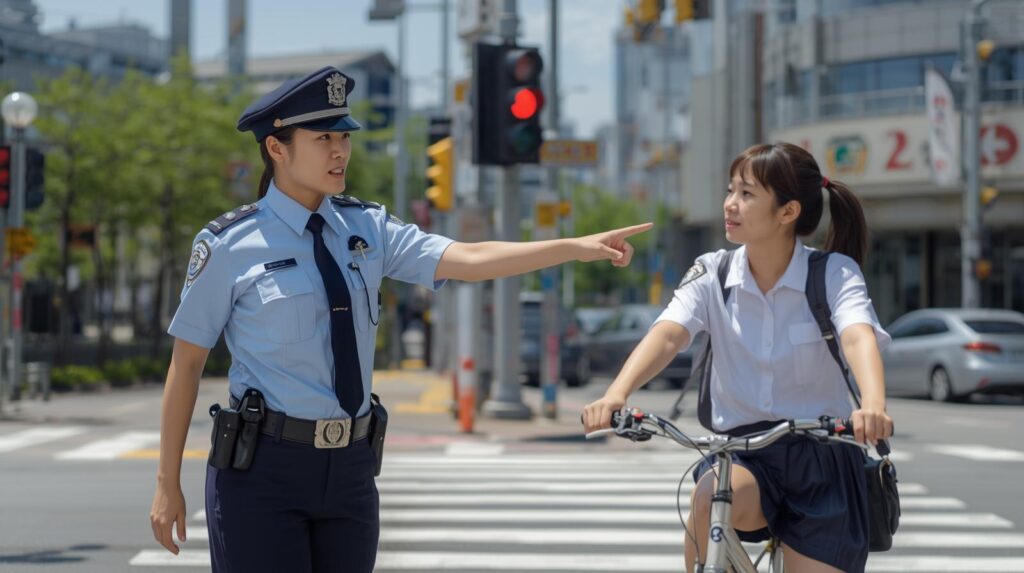

“The way you rode your bicycle yesterday could cost you 5,000 yen today.”
After stricter penalties introduced in November 2024 (smartphone use and drunk cycling), Japan will start a new enforcement system in April 2026: the “Blue Ticket” fine system for cyclists aged 16 and over.
Even careful riders can get fined due to everyday “blind spots.” This article explains what will change and the practical habits that help you avoid penalties—while staying safer on the road.
目次
1) What is the Bicycle “Blue Ticket” System in Japan?
Until now, bicycle violations tended to end in either:
- Red ticket (serious cases, possible criminal charges), or
- Warning only (minor cases).
From April 2026, minor violations can be handled with a Blue Ticket—meaning an on-the-spot administrative fine, similar to car traffic tickets.
Key point: Paying the fine generally avoids criminal prosecution, but ignoring a ticket can lead to escalation (formal procedures and potential criminal consequences).
2) Five “Everyday” Situations That Can Get You Fined
① What counts as a “complete stop” at stop signs?
Police apply a standard close to what drivers face: a “rolling stop” may not count as stopping.
Three habits for a proper stop:
- Wheels fully stop (no movement at all)
- Put a foot down (strongly recommended in real-world enforcement)
- Look left and right after stopping
Where you must stop:
- Stop signs
- Railway crossings
- Before crossing sidewalks from the road (e.g., entering a building/driveway)
Wrong: Rolling slowly at 1–2 km/h
Correct: Full stop + foot down + visual safety check
② Sidewalk riding: when it’s allowed and how slow you must go
Bicycles are legally treated as vehicles, so the default rule is ride on the left side of the road. Sidewalk riding is only allowed in limited situations such as:
- A sign permits bicycle use on the sidewalk
- The rider is under 13, 70+, or has certain physical limitations
- The road is dangerous (construction, heavy traffic, blocked by parked cars, etc.)
If you ride on a sidewalk:
- Pedestrians have priority at all times
- Ride on the roadway side of the sidewalk
- Go at walking pace (about 4–5 km/h) and be ready to stop immediately
Important: Using the bell to force pedestrians to move can be treated as improper use in many situations.
Wrong: 10+ km/h in the middle of the sidewalk
Correct: Roadway side + walking pace + stop if needed
③ Right turns: why the “right-turn lane” is a trap
For bicycles, the safe and lawful method is the two-step right turn.
Two-step right turn (simple steps):
- Keep left and go straight through the intersection
- Stop at the far corner and turn your bicycle to face the desired direction
- Wait for the green light in that direction, then proceed
Do NOT:
- Move into the car right-turn lane
- Cut diagonally across the intersection
- Follow a right-turn arrow signal like a car
④ Rain riding: umbrella use becomes a bigger risk
Riding while holding an umbrella is considered unsafe operation. With the upcoming system, it becomes even riskier financially.
Better approach: Use a raincoat/poncho plus a helmet, ideally with a clear visor for visibility.
Watch out for:
- Hoods blocking side vision
- Reduced hearing (rain + hood)
- Long hems getting caught in wheels/chain
⑤ Carrying children: “front carry” can be a serious mistake
Bicycles are generally designed for one rider, with limited exceptions for carrying small children under specific conditions (child seats, certified two-child bicycles, etc.).
Common safe rule of thumb: If you must carry a baby, a stable setup is essential. Front baby carriers are typically unsafe because they block vision and affect balance.
Also remember: children’s helmets are widely recommended for safety.
3) Estimated Fine List (From April 2026)
| Violation | Estimated Fine | What People Miss |
|---|---|---|
| Running a red light | ¥6,000 | Includes signals that apply to your crossing situation |
| Failing to stop | ¥5,000 | “Rolling stop” may count as no stop |
| Riding on the right side (wrong-way) | ¥6,000 | Default is left-side road travel |
| Smartphone use while riding | ¥12,000 | May also trigger harsher penalties depending on the behavior |
| Riding side-by-side | ¥5,000 | “Chatting in parallel” can be targeted |
| No lights at night | ¥5,000 | Use a steady light; don’t rely on “forgetting” |
4) Three Things to Do Starting Today (Practical Defense)
- Map your stop signs: Review your commute/school route and identify every stop sign and crossing.
- Make lights automatic: Install auto lights or ride with lights on at all times.
- Check your bicycle insurance: Accidents can lead to very high compensation claims—insurance is cheap protection.
5) Final Thoughts: Rules Don’t Only Restrict You—They Protect You
Stricter enforcement may feel inconvenient, but it can also reduce collisions and protect cyclists as victims. Now you know the “blind spots,” you won’t lose money to avoidable mistakes.
Share this guide with your family and friends to help everyone ride safely.
Editor’s note: Many people are surprised by how strict “bell use” and “complete stop” standards can be. Safe riding is the best way to avoid fines—and accidents.